
Know your current skill level with a baseline test
A baseline test is a crucial component of any effective aim training program. It captures your current skill level and will help make your training challenging enough to avoid stagnation and plateaus. With the results of baseline tests, you will get valuable insights that you can use to fine-tune your program to your specific needs and skills.
Regular baseline testing lets you:
- Measure your progress over time
- Identify your areas of weakness
- Set realistic goals for your training
- Customize your training program for maximum effectiveness
What to consider for baseline testing
Several factors must be taken into account when performing a baseline test to get accurate and useful results.
Be consistent with time and settings
Consistency is one of the most important factors. You must maintain the same mouse sensitivity, game settings, and testing environment for all baseline tests. If you change your settings too often, you get results that are not as reliable.
Choose a time of day when you have the most energy. This is usually around noon, just before lunch. Here, you’re typically able to reach your peak performance consistently.
Warmup before the test
Warming up before the test will turn on those motor neurons running the specific aim movements you will be using. It doesn’t have to be more than a few minutes. If you decide to do a warm-up before testing, you need to make sure to do it before each of the future tests.
How to perform a baseline test in CS2
There are several ways to perform a baseline test to find your current skill level. First, you need to decide which aspect of your aim you want to test. This could be one of the following metrics:
1: Accuracy
2: Shooting speed
3: Flick accuracy
4: Tracking ability
5: Target acquisition time.
Let’s keep it simple and use shooting speed as an example.
To perform a baseline test based on shooting speed, follow these steps:
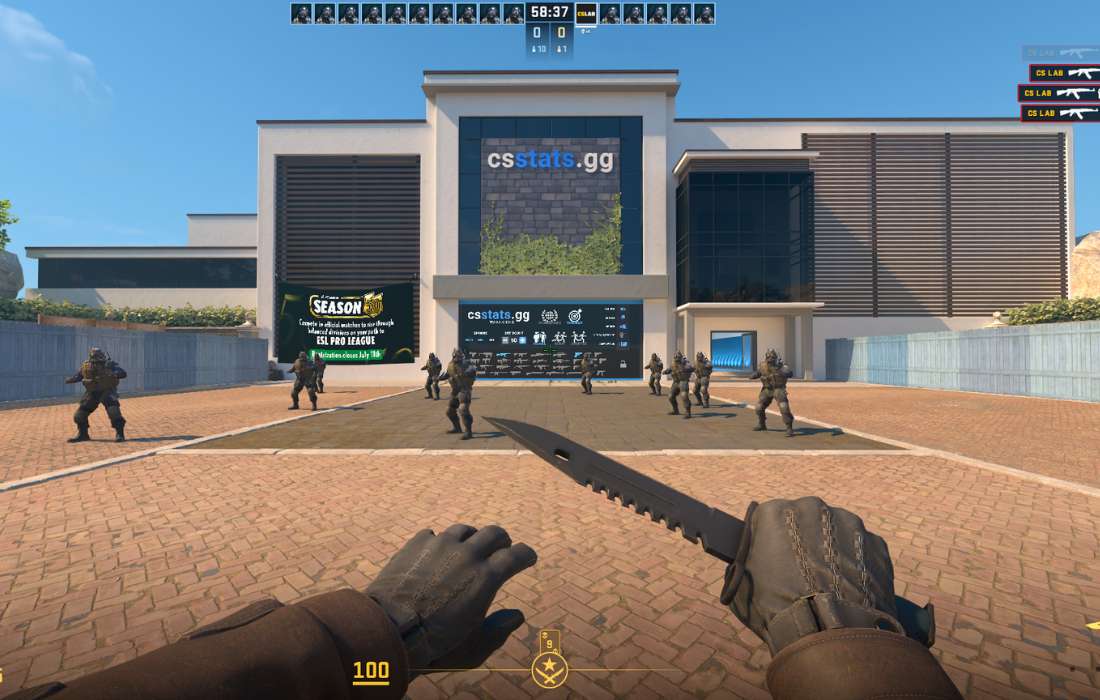
A) Enter Aim Botz training map. Close 3 of the 4 sections so the bots only stand in front of you.
B) Start a 100 kill speed challenge that measures your kills per minute (KPM).
C) Perform 10 rounds and write down the KPM after each round.
D) Calculate the average KPM score by dividing the sum of all KPMs by the total number of rounds. This is the result of your baseline test.
Round 1: 82 KPM
Round 2: 79 KPM
Round 3: 81 KPM
Round 4: 83 KPM
Round 5: 80 KPM
(82 + 79 + 81 + 83 + 80) / 5 = 81 KPM
How often should you do a retest?
To adjust your aim training program, you need to do regular baseline testing. This could be once every month or every 6 weeks. It depends on how your training program is structured.
In our Metronome Aim Training Program you perform a comprehensive baseline test of 30 rounds before a 6-week training period starts.
Try not to be caught up in the day-to-day improvements, but see the progress in the bigger picture. Remember, it takes time and consistent practice to get good results. Seeing the bigger picture takes off some of the pressure and frustrations you can feel if you’re not seeing instant results.