How to Improve Your Aim Faster with Science
It takes time and practice to get a better aim. But what if there was a smarter way to train that helps you get better, faster?
A study published in Frontiers in Psychology showed that how you train your aim can make a big difference. Instead of just playing deathmatch or grinding aim trainers for hours, using personalized adaptive training helped players see much better results.
Let’s break down the study and how you can use the results to improve your aim.
The Study Setup
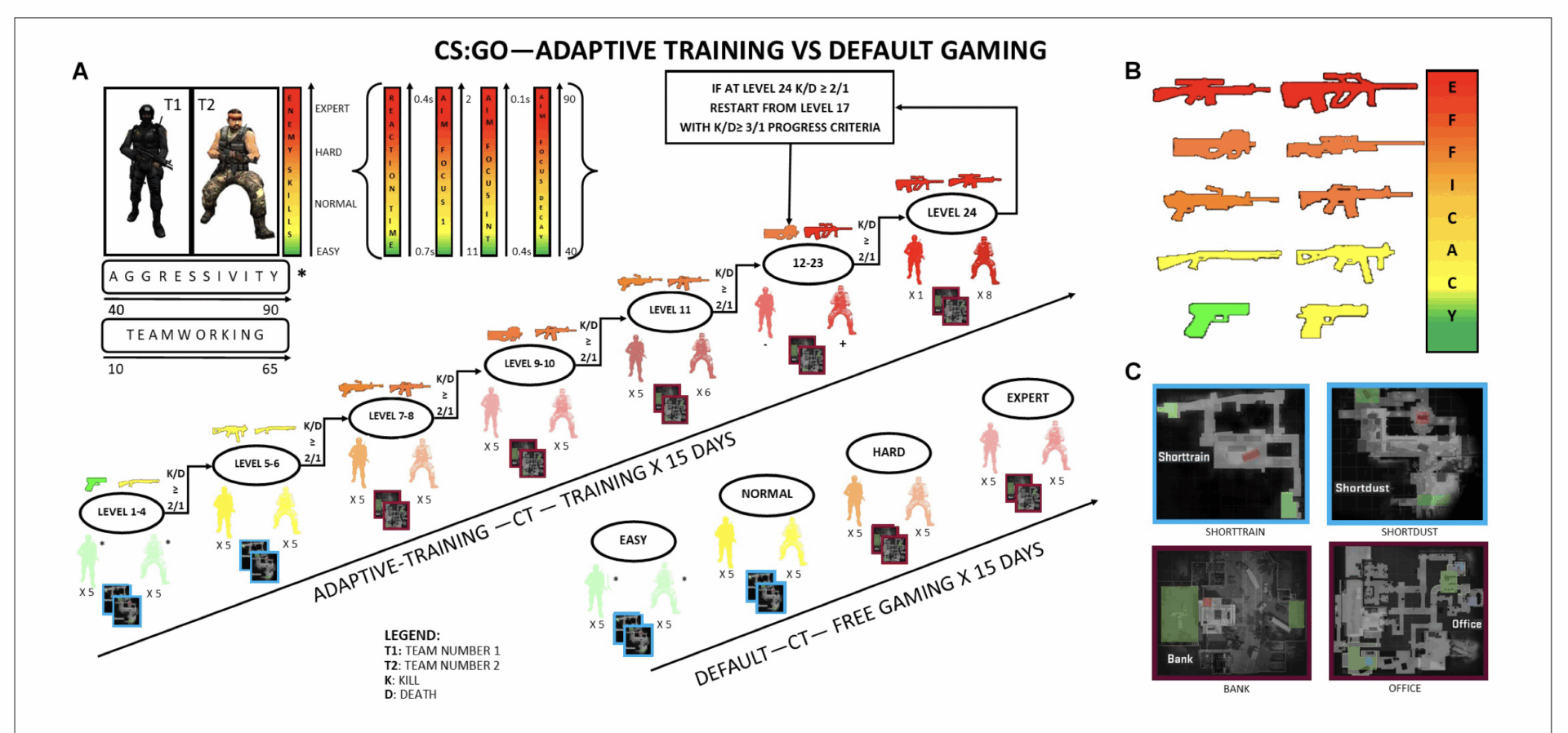
A total of 21 players were selected for the study. None of them were pro-level, but they had some experience playing Counter-Strike (around 3–5 hours per week). All of them trained for 3 weeks, doing 2 hours per day.
Two Groups
The 21 players were split into two groups:
Adaptive training group
Standard training group
Daily Training Structure
Warm-up: All players started each session with a 10-minute warm-up.
Main training block: After warming up, they played deathmatch against bots.
Adaptive training group
This group had bots that changed difficulty based on their performance. If they were performing well, the bots became harder. If they were struggling, they became easier. This created a constant dynamic adjustment that kept the players’ challenges at the most optimal level.
Standard training group
This group had to choose one of four difficulty levels (Easy, Medium, Hard, or Expert), and continued training at that difficulty for the entire period. They were not allowed to change the difficulty, even if the training became too easy or too hard.
Variation in training
To keep the training varied, both groups were not allowed to play the same map more than twice in a row.
Rest period
Players had short breaks built into the 2-hour session to avoid fatigue and maintain focus.
What the Researchers Measured
To understand how training affected the two groups, all players underwent performance tests three times: before the training period, after the end of training, and three months later.
The researchers wanted to see two things:
- Did the players get better at aiming and performing in-game?
- Did the training also improve their mental and cognitive abilities?
In-Game Performance
The first part of the testing focused on how well the players performed inside the game. The most direct measurement was their kill-to-death ratio (K/D)—how many enemies they eliminated before dying. This is a basic but useful way to track overall skill.
Because the adaptive group was constantly facing harder bots as they improved, the researchers also used something called a corrected K/D. Here, the K/D ratio was multiplied by the bot difficulty level, giving a more accurate picture of how much each player had improved over time. This made it easier to compare the two groups fairly.
Timed Aim tests
Players also went through two timed aim tests. These were special maps where they had to eliminate 60 bots as fast as possible. One map was open and spacious, the other was tighter and more closed off. This tested how well they could apply their aim under different conditions.
Shooting Tasks
In addition to that, the players completed six different shooting tasks, each repeated 20 times. These tasks measured how many targets they hit or missed and how quickly they reacted. Some involved static targets, others involved targets moving in patterns or appearing with delays, designed to simulate a variety of aiming challenges.
Cognitive Skills
The researchers also wanted to find out whether this kind of aim training could sharpen the brain. So they tested each player’s reaction time, attention, visual scanning ability, task switching, and decision-making.
For example, one task measured how fast players could spot a target hidden among distractions. Another tested how quickly they could switch between different instructions on the fly. There were also tasks that measured how quickly and accurately they responded to short visual flashes, as well as their ability to spot and track moving objects across their visual field.
These tests were repeated at all three time points to see not just short-term changes, but whether any improvements stuck over time.
Let’s Take a Look at the Results
Now that we know what the researchers measured, we can take a closer look at how the players performed after three weeks of training.
In-Game Performance
The players in the adaptive training group clearly improved more than those in the standard group, especially when it came to overall gameplay.
The most important measure was the kill-to-death ratio (K/D). While both groups got better over time, the adaptive group showed a faster and more consistent improvement. What really stood out was their corrected K/D.
The adaptive group ended up facing bots that were more than 2.5 times harder than the ones used by the standard group.
The difference between groups was statistically significant (p = 0.017), meaning it was not just random.
Timed Aim tests
When it came to the timed aim tests, both groups completed the aim courses faster after training. But the adaptive group had the largest improvement. In Aim Course 1, they reduced their time by almost a full minute, and in Aim Course 2, by around 45 seconds. This suggests their speed and efficiency in handling in-game tasks improved more quickly.
Shooting Tasks
The results from the target shooting tasks also showed a clear trend. The adaptive group improved in every task. They hit more targets and made fewer mistakes across all six exercises.
For example, in a test that combined static and moving targets, they increased their hit rate while cutting the number of failed attempts nearly in half. The standard group also improved, but their progress was slightly more uneven.
Cognitive Skills
Besides getting better at aiming, the players also improved in several important mental abilities.
Both groups showed progress across all areas, but the adaptive training group generally performed slightly better. However, the differences between the two groups were not statistically significant.
Reaction Time
Players were tested on how fast they could respond to simple visual cues or repeated patterns. After training, they reacted more quickly and with fewer delays. This suggests better coordination between what they saw and how fast they responded, which is especially useful in high-speed game situations.
Attention
One of the tests challenged players to detect brief or fast-moving visual events while ignoring distractions. After the training, players were better at noticing those short flashes or sudden changes, meaning their focus had improved and they were less likely to miss critical information.
Visual Scanning Ability
Another test required players to search for a specific target among a set of distracting elements. Over time, they got faster at spotting the right item while ignoring irrelevant details. This shows an improved ability to scan complex visual scenes—exactly what’s needed when checking corners or scanning the minimap under pressure.
Task Switching and Flexibility
Players were also tested on how well they could shift between different instructions or patterns. Before training, many hesitated when the task changed. But after training, they adapted more smoothly and with fewer mistakes. This shows stronger mental flexibility—key for situations where strategies change mid-game.
Decision-Making
Finally, players were tested on how fast they could detect important visual information and decide where to focus. After the training, they processed these situations faster and responded more accurately, suggesting better real-time decision-making.
WHY ADAPTIVE TRAINING WORKS
When you’re pushed just enough—not too easy, not too hard—your brain stays engaged, and your skills improve faster. You’re constantly challenged, which forces your brain to stay alert and adapt to new challenges.
This is exactly what the adaptive training group experienced. Because the game responded to their performance, they were always training at the edge of their ability.
If the difficulty stays the same, your brain will stop adapting. You fall into autopilot, and progress slows down. Soon, you hit that plateau, where you keep practicing, but you don’t get any better.
Adaptive training breaks that pattern. By gradually increasing the challenge, you keep improving without getting overwhelmed.
You don’t need to guess how hard to push yourself. You need structure, challenge, and progression.
Ready to Put Science Into Practice?
Improve your aim with structured, personalized training inspired by the principles behind adaptive learning. Start with a baseline test, then progress week by week with increasing challenge.
👉 Start the Metronome Aim Training Program
Conclusion
The conclusion is clear: players using the adaptive version of the game progressed significantly faster in terms of in-game performance. Dynamically adjusting the difficulty based on individual performance leads to greater improvements compared to traditional training methods.
If you want to improve faster, you should find a way to customize and adjust your training to fit your performance level.