
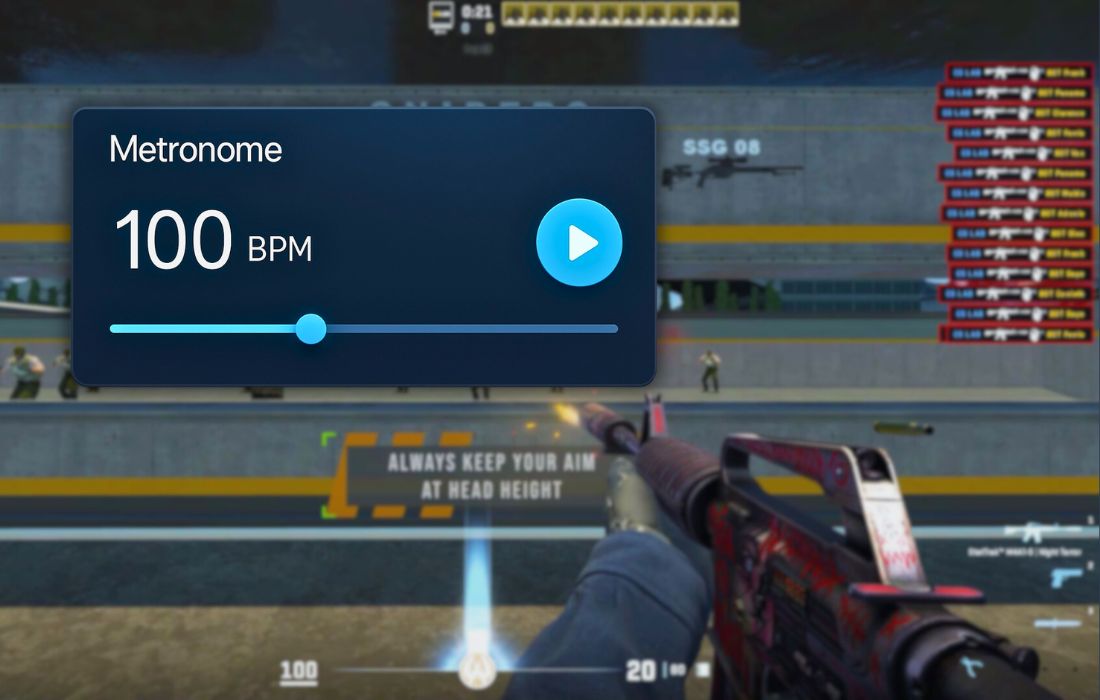
Why you should start using a metronome in Aim Training
Ever feel like your aim just isn’t improving, no matter how many hours you put in? You’re not alone. Most players focus on sensitivity, mouse upgrades, or fancy routines, but there’s one tool almost everyone overlooks: the humble metronome.
A metronome isn’t just for musicians or drummers—it’s one of the most underrated secrets for boosting aim consistency. By syncing your shots to a steady beat, you tap into your brain’s natural rhythm, train sharper focus, and build up muscle memory faster than by mindlessly grinding away.
In this article, we’ll break down why metronome aim training deserves a spot in your routine, the science behind it, and how you can start seeing results—whether you’re a casual gamer or grinding for the top ranks.
Ready to take your aim to the next level? Let’s dive in.
How a Metronome Sharpens Your Focus
Let’s be honest—staying locked in for a full aim training session isn’t easy. Your mind drifts, you start thinking about something else, and suddenly your shots go wild. A metronome changes that. The steady beat acts like a mental anchor, pulling your attention back to the moment. Each click keeps you focused on when to take your shot, not just where to aim.
Over time, this rhythm-driven focus makes it easier to block out distractions and get into a true flow state. You stop overthinking every movement, and instead, your body and mind sync up with the beat. The result is more mindful reps, sharper concentration, and a noticeable boost in your consistency—both in training and in real matches.
Building Muscle Memory – The Smart Way
If you want your aim to feel natural and automatic, developing muscle memory is key. But it’s not just about grinding through endless practice—how you practice makes a big difference. When you train with a metronome, each shot happens at a set rhythm, locking in the timing as well as the motion.
Practicing this way helps your brain and muscles work together more efficiently. Over time, your reactions become smoother and more precise, and you start to notice that aiming feels less like a conscious effort and more like second nature. This isn’t just a gamer myth—scientific research shows that pairing movement with a rhythmic cue actually strengthens the neural pathways that control both timing and precision.


6 WEEKS AIM TRAINING PROGRAM
CUSTOMIZING YOUR TRAINING – FOR ANY SKILL LEVEL
One of the biggest advantages of using a metronome is how easy it is to tailor your training. You’re not locked into a single speed or routine. Instead, you can adjust the tempo to fit your current skill level or challenge yourself with something new.
If you’re just starting out, a slower beat gives you plenty of time to line up each shot and focus on form. As you get more confident, you can gradually ramp up the BPM, forcing your reflexes and coordination to keep up. Whenever you feel like you’re stuck at a certain level, increasing the tempo just a bit can push you out of your comfort zone and help you break through that plateau.
KEEPING TRAINING FRESH WITH VARIATION
Let’s face it—doing the same drills over and over can get boring fast. The metronome makes it easy to keep things interesting by letting you change up the rhythm whenever you want. Maybe you start your session slow and steady, then pick up the pace for a few rounds before bringing it back down to focus on precision.
This kind of variety isn’t just for fun—it actually helps your brain adapt to different tempos and scenarios, which translates to better performance in real matches. Mixing up your training keeps you engaged and ensures that every session offers something new for your aim to adapt to.
MEASURING YOUR PROGRESS AND STAYING MOTIVATED
It’s hard to stay motivated if you can’t see your progress, but with metronome training, improvements are easy to track. As you work through different tempos, you’ll notice when a pace that once felt challenging starts to feel comfortable. That’s clear evidence that your skills are improving.
This steady, visible progress is a great motivator. It gives you something concrete to aim for—like reaching a new BPM milestone or mastering a faster rhythm. If you want to take things further, structured aim training programs that use metronome work can provide even more benchmarks and routines to help you level up.
Ready to Level Up Your Aim?
In a scene where everyone’s chasing the next big gear upgrade or tweaking settings, it’s easy to overlook the basics. The metronome is one of those rare tools that actually lives up to the hype. Its benefits are grounded in neuroscience and real experience, helping you train smarter, stay focused, and build skills that last.
If you’re looking for a simple, proven way to get more out of every practice session, give our 6 weeks metronome aim training program a try. It might just be the game changer your aim has been waiting for.
References
Grahn, J. A., & Brett, M. (2007). Rhythm perception in motor areas of the brain. J. Cogn. Neurosci., 19(5), 893–906.
Thaut, M. H., & Abiru, M. (2010). Rhythmic auditory stimulation in rehabilitation of movement disorders: A review. Music Percept., 27(4), 263–269.
Repp, B. H. (2005). Sensorimotor synchronization: A review of the tapping literature. Psychon. Bull. Rev., 12(6), 969–992.